 how-to
Myofascial Release Marlow: What to Expect, Techniques & Time
Table of Contents
- Myofascial Release Marlow: How Hands-On Therapy Eases Stubborn Tightness
- What to Expect From Myofascial Release at Your First Appointment
- Myofascial Release Techniques Used in Clinic
- Myofascial Release Exercises You Can Try at Home
- How Long Does Myofascial Release Take to Work?
- Who Myofascial Release Helps: Runners, Office Workers and Active Adults
- Conclusion: Getting Started With Myofascial Release in Marlow
- Frequently Asked Questions
Last Updated: 9 October 2026
Myofascial Release Marlow: How Hands-On Therapy Eases Stubborn Tightness
Myofascial release is a hands-on therapy that applies slow, sustained pressure to the connective tissue around your joints and muscles to ease tightness, restore movement and reduce pain. At Marlow Movement Clinic, we use it as part of a full rehabilitation plan, not a one-off rub-down. If you have a shoulder that will not fully rotate, a calf that tightens every time you run, or a back that aches after a long day at a desk, the soft tissue around the muscle is often part of the problem.
This guide covers what myofascial release in Marlow actually involves, which techniques we use, what you can do at home, and how long results tend to take.
What Fascia Is and Why It Matters for Movement
Fascia is a web of connective tissue that wraps every muscle, bone, nerve and organ in the body. It holds structures together and lets them slide against each other as you move.
When fascia stays healthy, it glides. When it gets irritated, dehydrated or overloaded, it can thicken and stick to nearby tissue. That is when movement starts to feel restricted.
You might notice it as:
- A joint that stops short of its full range
- A dull ache that never quite goes away
- Tightness that returns days after a massage
- Pain that moves around rather than staying in one spot
Fascia is extremely good at redistributing tension to other parts of the body, so problems often build quietly before you feel them.
What to Expect From Myofascial Release at Your First Appointment
Your first session starts with an assessment. We ask about your history, what makes the pain better or worse, and what you want to get back to. Then we look at how you move.
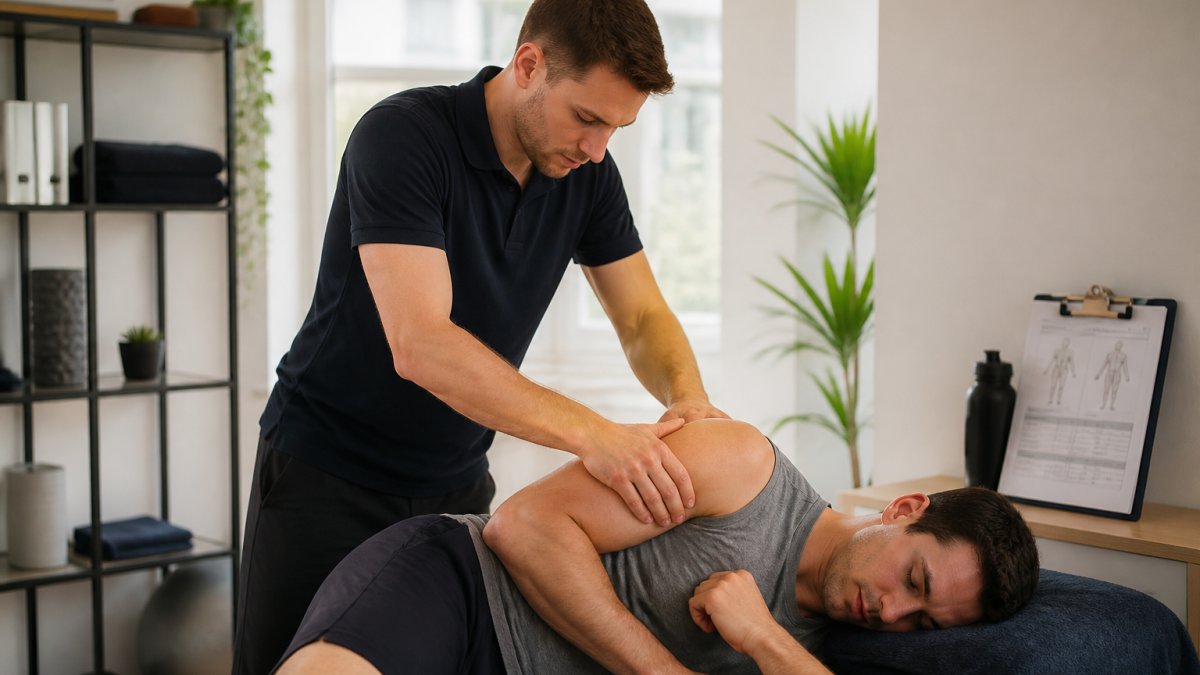
Sports therapist performing myofascial release on a client's shoulder in a bright treatment room
A sports therapist using hands-on soft tissue techniques on a client's shoulder.
Assessment, Treatment and Your Rehab Plan
The assessment covers posture, joint range, muscle strength and how your tissue responds to touch. From there, treatment usually runs 30 to 45 minutes, followed by a short set of exercises.
The pressure is slow and sustained, often combined with active movement. It is not a deep-tissue sports massage. Expect a firm, steady contact that you breathe through rather than a fast, kneading motion.
After a appointment you should have:
- A clear idea of what is driving your symptoms
- Two or three exercises to do before your next visit
- A rough timeline for how many sessions you may need
Some people feel mild soreness for a day or so. That is normal and usually settles.
Check availability and book online →
Myofascial Release Techniques Used in Clinic
Graduate Sports Therapy draws on several hands-on methods. Which one we use depends on the tissue, the joint and how you respond.
Common techniques include:
- Sustained pressure: slow, direct contact held for 60 to 90 seconds until the tissue softens
- Soft tissue mobilisation: layered strokes that work through skin, fascia and muscle
- Assisted stretching: we take the joint through range while you stay relaxed
- Neuromuscular facilitation: working with the nervous system to switch a muscle back on
- Targeted exercise rehabilitation: loading the tissue so the change actually holds
For more background on how fascia responds to this kind of work, the NHS information on musculoskeletal pain is a useful starting point.
How This Differs From Sports Massage
Sports massage works on muscles. Myofascial release also works on the connective tissue around and between them.
Massage tends to use faster, deeper strokes aimed at loosening muscle. Myofascial work uses slower pressure held for longer, with the goal of changing how tissue slides and how the joint moves.
The bigger difference is what comes next. A massage ends when you leave the table. Myofascial release is paired with movement, because tissue that is freed but not loaded will quickly tighten again.
Myofascial Release Exercises You Can Try at Home
These exercises are a general starting point, not a treatment plan. If a movement makes your pain worse, stop and get it looked at.
- Calf release with a ball: sit on the floor, place a firm ball under your calf and roll slowly for 60 seconds per spot
- Thoracic extension over a rolled towel: lie on your back with a towel roll under your mid-back, breathe out and let your chest open for 2 minutes
- Doorway chest stretch: forearms on the frame, step through gently and hold for 30 seconds, three times
- Hip flexor lunge stretch: half-kneel, tuck your pelvis and hold for 30 seconds each side
Shoulder slides on a wall: keep your back flat against a wall, slide your hand and arms up and down for 10 slow reps
A simple rule: hold, breathe, and let the tissue soften rather than forcing it.
How Long Does Myofascial Release Take to Work?
Most people notice some change after the first session, usually easier movement rather than full pain relief. That early change often fades within a day or two.
Real change comes from repetition. A typical course runs four to six sessions over several weeks, with home exercises in between. Chronic problems that have built up over months or years take longer than a recent strain.
What speeds it up:
- Doing your exercises between sessions
- Sleeping and eating well enough to recover
- Not going straight back to full training load
What slows it down:
Check availability and book online →
- Stopping as soon as you feel better
- Ramping training back up too fast
- Only treating the sore spot and ignoring how you move
Who Myofascial Release Helps: Runners, Office Workers and Active Adults
You do not need to be an athlete to benefit. Most of the people we see fall into three groups.
Runners and gym-goers often come in with calves, hamstrings or shoulders that will not loosen. Training load is usually part of the picture.
Office workers tend to present with neck, shoulder and lower back tightness from long hours in one position. Posture plays a role, but so does the fact that the tissue has not moved through full range all day.
Active adults dealing with long-standing back or joint pain often find that hands-on work plus a graded exercise plan gives them a way back in.
If you have tried physiotherapy before and the exercises did not stick, that is a common story. The difference here is pairing hands-on treatment with a plan you can actually follow, week by week.
Conclusion: Getting Started With Myofascial Release in Marlow
Stubborn tightness rarely has a single cause, and it rarely resolves on its own. Hands-on work can unlock tissue, but the exercises you do between sessions are what keep it unlocked.
At Marlow Movement Clinic, we combine soft tissue mobilisation, assisted stretching and targeted rehabilitation into one plan. We offer a free 15-minute phone consultation, same-day appointments are often available, and our Clinical Lead Mark Skoyles (BSc Hons) has been in practice since 1996. If you want to know whether myofascial release is right for your problem, book online and we will tell you honestly what we think.
Frequently Asked Questions
What is myofascial release and how does it differ from sports massage?
Myofascial release is a hands-on technique that applies slow, sustained pressure to fascia, the connective tissue surrounding muscles. Unlike sports massage, which often uses faster strokes, myofascial release holds pressure for longer to encourage tissue release. At Marlow Movement Clinic, a Graduate Sports Therapist combines this with movement-based rehab so the changes last beyond the session.
How many myofascial release sessions might I need?
The number of sessions depends on your injury history, how long you have had symptoms, and how you respond to treatment. Some people notice improvement after one or two sessions, while chronic issues may need a short course of treatment alongside home exercises. Your therapist will review progress and adjust the plan as you go.
Can I do myofascial release exercises at home?
Yes. Simple tools like a foam roller or massage ball can help you maintain results between appointments. Your therapist can show you which areas to target and how much pressure to use. Always start gently and stop if you feel sharp pain. Home exercises work best as part of a plan set by a qualified professional.
Do I need a GP referral to book myofascial release in Marlow?
No, you can book directly with Marlow Movement Clinic without a GP referral. A free 15-minute phone consultation is available if you want to discuss your symptoms first. If your therapist thinks you need further medical assessment, they will advise you to see your GP.