 how-to
Preventing Sports Injury Relapse: 7 Tips to Stay Healthy
Table of Contents
- Why Sports Injuries Relapse and How to Stop It
- Return to Sport Criteria: Know When You're Ready
- Progressive Loading in Sports Recovery: Building Strength Safely
- Sports Injury Rehabilitation Exercises That Prevent Re-injury
- Recognising Signs of Overtraining Before Injury Returns
- Building a Sustainable Return-to-Sport Plan
- Frequently Asked Questions
Last Updated: October 4, 2026
Why Sports Injuries Relapse and How to Stop It
Most people who return to sport too quickly end up back on the sidelines. The injury feels healed, so they push hard again. Then pain flares up, and they're stuck in a frustrating cycle.
Preventing sports injury relapse isn't about resting forever. It's about returning to activity in the right way, at the right pace. At Marlow Movement Clinic, we help athletes avoid re-injury by following a structured approach to recovery.
The truth is simple: relapse happens when you skip steps. You might feel ready to train hard again, but your tissues need time to rebuild strength and resilience. This guide will show you exactly how to progress safely, recognise warning signs, and build lasting protection against re-injury.
Return to Sport Criteria: Know When You're Ready
You're not ready to return to sport just because pain has gone away. Pain is only one part of the picture.
Return to sport requires meeting multiple criteria:
- Full pain-free range of motion in the injured area
- Strength that matches your uninjured side (at least 90% symmetry)
- Ability to do sport-specific movements without compensation
- Confidence in the injured area without fear of re-injury
- Cleared by a qualified professional, not just your own judgement
Many athletes rush back because they feel better for a few days. That's a trap. Real readiness means you can perform the movements your sport demands without changing your technique to protect the injury.
A Graduate Sports Therapist can assess whether you meet these criteria through specific tests and functional movements. This takes the guesswork out of the decision.
Progressive Loading in Sports Recovery: Building Strength Safely
Progressive loading means gradually increasing the demands you place on your body. This is how tissues rebuild strength and resilience without breaking down again.
The principle is straightforward: start with low-load movements, then increase load, range, speed, and complexity over time. Each step should feel manageable before you move to the next.
A basic progression looks like this:
- Week 1-2: Gentle movement, pain-free range only
- Week 3-4: Add light resistance, controlled tempo
- Week 5-6: Increase resistance, introduce sport-specific patterns
- Week 7-8: Build speed and power, approach sport demands
- Week 9+: Return to full training with ongoing monitoring
The timeline varies depending on your injury type and severity. A minor ankle sprain progresses faster than a serious knee injury. A qualified professional helps you move through these stages at the right pace for your specific situation.
Check availability and book online →
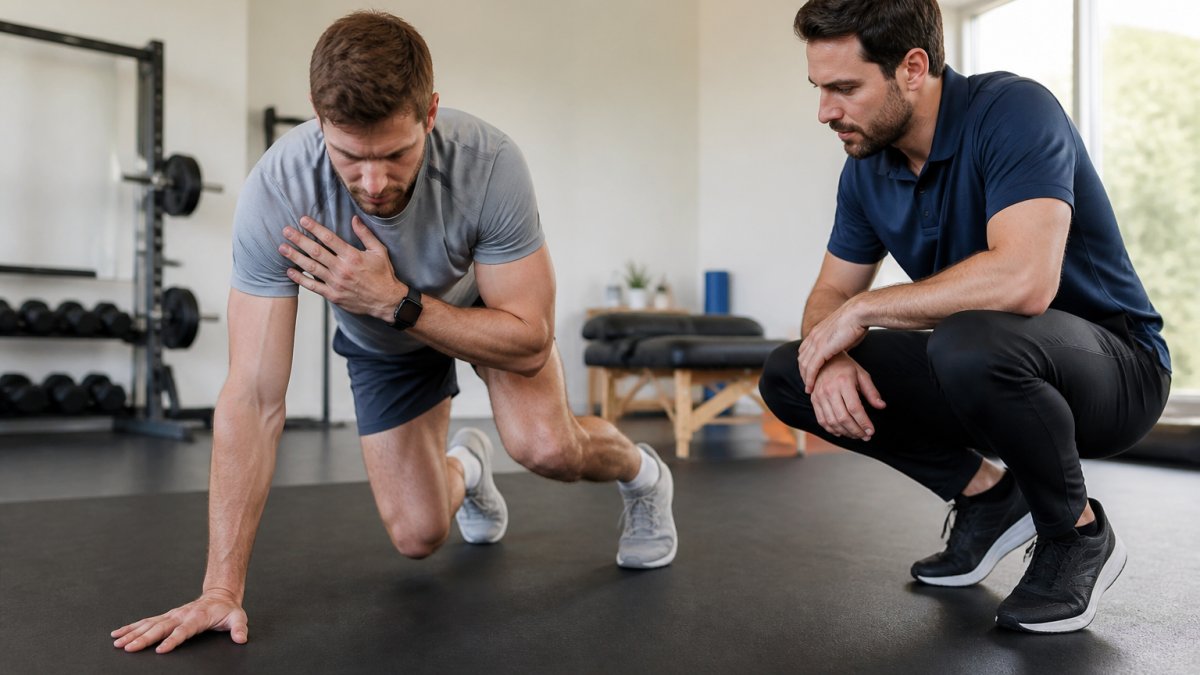
One common mistake is jumping too many steps at once. You feel strong one week, so you train hard the next. Your body isn't ready for that jump, and pain returns. Patience with progression is what prevents relapse.
Sports Injury Rehabilitation Exercises That Prevent Re-injury
The exercises you do during recovery aren't just about regaining strength. They teach your body how to move correctly again and build confidence in the injured area.
Rehabilitation exercises target three key things:
- Strength: Muscles that support the injured joint or area
- Stability: Control and balance during movement
- Movement quality: Proper technique without compensation patterns
Your rehabilitation plan should be specific to your injury and sport. A runner needs different exercises than a tennis player. A shoulder injury requires different work than a knee injury.
Common rehabilitation approaches include:
- Isometric exercises (holding positions without movement)
- Isotonic exercises (moving through a range with same resistance)
- Functional movements (patterns that match your sport)
- Balance and proprioception work (awareness of body position)
- Sport-specific drills (practising movements from your activity)
The key is consistency. You need to do these exercises regularly, not just once a week. Most athletes benefit from 3-4 sessions per week, either supervised or at home with clear guidance.
A Graduate Sports Therapist designs a programme tailored to your injury and goals. This removes the uncertainty of "am I doing the right exercises?" and gives you a clear path forward.
Recognising Signs of Overtraining Before Injury Returns
Overtraining is silent. You don't always feel it coming until pain flares up again.
Learning to recognise early warning signs means you can ease back before relapse happens. Small adjustments now prevent major setbacks later.
Watch for these signs of overtraining:
- Pain that increases during or after activity (not just at the start)
- Swelling or puffiness in the injured area
- Stiffness that doesn't improve with warm-up
- Persistent soreness that doesn't resolve with rest days
- Fatigue that feels disproportionate to your training load
- Difficulty sleeping or feeling unusually irritable
- Elevated resting heart rate (5+ beats higher than normal)
- Reduced performance despite training hard
Pain during activity is the clearest signal to reduce load. It means tissues are being stressed beyond what they can handle right now. Pushing through that pain often leads directly to relapse.
Many athletes also notice mood changes or sleep disruption before physical symptoms appear. Your body is sending signals that it's overwhelmed. These mental and emotional signs matter as much as physical ones.
Check availability and book online →
Building a Sustainable Return-to-Sport Plan
A sustainable plan isn't just about getting back to sport. It's about staying there without re-injury.
This means building in ongoing maintenance work, even after you return to full training. The exercises that got you healthy need to continue, adapted to fit your new training schedule.
Your sustainable plan should include:
- A clear timeline from current state to full return
- Specific exercises to do each week
- Criteria for moving to the next phase
- How to progress training volume and intensity
- Which movements to avoid or modify long-term
- Signs that mean you need to step back
- A plan for when you hit setbacks
Most athletes benefit from working with a qualified professional to build this plan. Marlow Movement Clinic creates personalised return-to-sport plans based on your injury, your goals, and your sport. You get clarity on what to do each week.
The plan also includes education: understanding your injury, knowing why you're doing each exercise, and learning how to manage your body long-term. This knowledge helps you stay healthy after you leave the clinic.
Preventing sports injury relapse comes down to respecting the recovery process. Your body has healed the initial injury, but it needs careful management to rebuild full strength and resilience. A structured approach, starting with clear return-to-sport criteria, progressing load gradually, doing targeted rehabilitation exercises, and watching for overtraining signs, keeps you healthy and confident in your sport.
If you're recovering from a sports injury and want expert guidance on returning safely, Marlow Movement Clinic offers personalised rehabilitation plans tailored to your injury and goals. Our Graduate Sports Therapist assessments identify exactly where you are in recovery and what you need to progress. We combine hands-on treatment with clear exercise plans so you understand each step forward. BOOK ONLINE for a consultation, or call for a free 15-minute phone discussion about your recovery.
Frequently Asked Questions
Why do sports injuries often recur?
Sports injuries relapse when rehabilitation is incomplete, return to activity happens too quickly, or underlying movement patterns aren't corrected. Many people resume their sport before regaining full strength, proprioception (body awareness), or addressing the original cause of injury. A Graduate Sports Therapist identifies these gaps through assessment of movement quality and strength, ensuring your body is genuinely ready before you return to full training.
How do I know if I am ready to return to sport after an injury?
True readiness involves meeting specific criteria: pain-free movement through full range, strength equal to your uninjured side, ability to perform sport-specific movements without compensation, and psychological confidence. You should pass functional tests relevant to your sport—for example, a runner should manage single-leg balance and controlled deceleration without pain. A qualified professional can assess these objectively rather than relying on how you feel alone.
What are the signs that a sports injury is returning?
Early warning signs include sharp pain during specific movements, swelling that reappears after activity, stiffness that worsens rather than improves, or loss of strength you'd regained. Subtle signs matter too: limping without noticing, avoiding certain movements, or compensating with other body parts. Catching these early—before they become full re-injury—is why monitoring your movement patterns during recovery is essential.
How can I build resilience in my muscles to prevent re-injury?
Progressive loading—gradually increasing exercise intensity, volume, and complexity—builds muscle resilience. This means starting with basic strength work, progressing to sport-specific movements, and finally returning to full training. Consistency matters more than intensity: regular, controlled exercise over weeks builds genuine adaptation. Including eccentric exercises (lengthening under load) and proprioceptive work (balance, coordination drills) strengthens not just muscle but the neural control that prevents injury.