 blog
Best Exercises for Office Worker Posture
Table of Contents
- Why Office Worker Posture Matters
- Desk Stretches for Neck Pain
- How to Improve Posture While Sitting at a Desk
- Exercises for Upper Back Pain Office Workers
- Building a Daily Routine That Works
- Common Mistakes to Avoid
- When to Seek Professional Support
- Frequently Asked Questions
Last Updated: 20 September 2026
Why Office Worker Posture Matters
Long periods of time at a desk causes chronic pain because your body has to adapt to repetitive movements and positions over time. Chest muscles tighten, shoulders round forward, and neck juts ahead of your spine, creating muscular imbalances that lead to neck pain, upper back pain, and headaches.
Human bodies did not evolve for sustained sitting (or standing) at a desk. Monitors sitting too low, chairs lacking lumbar support, and keyboards forcing wrists and fingers annd shoulders into repetitive, awkward angles and movements. Your body will try to compensate for ‘unnatural’ repetitive activity by recruiting other muscles that can fatigue quickly. Muscular imbalances caused by some muscles overworking are compounded over time.
Desk related pain problems respond well to targeted exercise that addresses the root cause: muscular imbalance. Tight muscles need to lengthen, weak muscles need to strengthen, and your nervous system needs to relearn what good posture feels like.
This guide covers effective exercises for office worker posture and how to build a sustainable routine that fits your working day.
Desk Stretches for Neck Pain
Neck pain from office work stems from tight muscles in the front of your neck and upper chest, combined with weak muscles in the back. The stretches below target these specific muscles.
Neck Flexion Stretch
The neck flexion stretch targets the muscles along the back of your neck and upper back, which become chronically tight from holding your head up all day.
How to perform it:
- Sit upright in your chair with feet flat on the floor
- Slowly lower your chin toward your chest
- Feel the stretch along the back of your neck and between your shoulder blades
- Hold for 20-30 seconds
- Return to starting position and repeat 3 times
Why it works: This stretch lengthens the posterior chain of your neck and upper back, allowing your head to sit naturally over your shoulders.
Modifications:
- Beginner: Hold the stretch for 15 seconds and repeat twice
- Advanced: Gently press your hands on the back of your head to deepen the stretch (avoid forcing it)
Lateral Neck Stretch
Lateral neck stretches target the muscles on the sides of your neck. These muscles often become tight on one side, creating postural imbalance.
How to perform it:
- Sit upright with your shoulders relaxed
- Tilt your right ear toward your right shoulder
- Keep your shoulders level, don't shrug
- Hold for 20-30 seconds
- Return to centre and repeat on the left side
- Perform 3 repetitions on each side
Why it works: Balanced flexibility on both sides prevents compensatory patterns and strain on the opposite side.
Modifications:
- Beginner: Hold for 15 seconds per side
- Advanced: Gently place your right hand on your head and apply light pressure to deepen the stretch
Chin Tucks
Chin tucks are highly effective at retraining your neck position for office worker posture.
How to perform it:
- Sit upright and look straight ahead
- Without tilting your head forward, draw your chin straight back
- You should feel a gentle contraction at the back of your neck
- Hold for 5-6 seconds, or one slow breath.
- Release and repeat 15 times
Why it works: Chin tucks activate the deep neck flexors that support proper head position. These muscles are usually weak in office workers, and strengthening them helps your head sit naturally over your shoulders.
Modifications:
- Beginner: Perform 10 repetitions, rest, then repeat
- Advanced: Hold each repetition for 5 seconds
How to Improve Posture While Sitting at a Desk
Improving office worker posture requires strengthening weak muscles and retraining your nervous system. The exercises below target the muscles responsible for holding good posture throughout your working day.
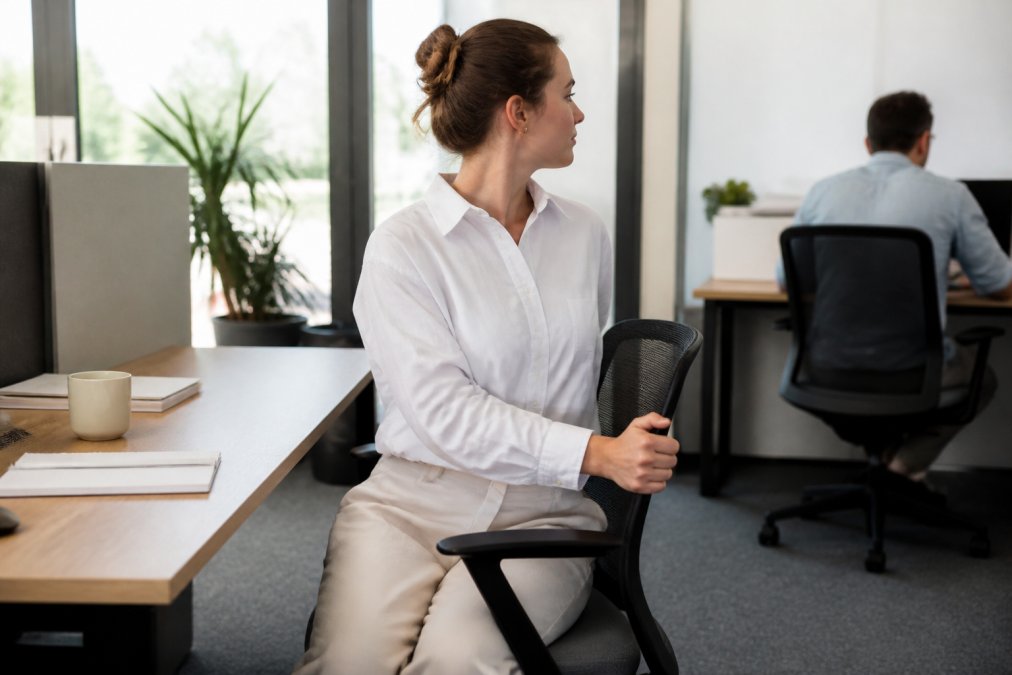
Seated Spinal Rotation
Spinal rotation improves mobility through your mid-back and engages stabilising muscles. This movement pattern is crucial for office worker posture because it reverses the forward-facing position you maintain all day.
How to perform it:
- Sit upright in your chair with feet flat
- Cross your arms across your chest, right hand on left shoulder, left hand on right shoulder
- Slowly rotate your torso to the right, leading with your shoulders
- Keep your hips facing forward
- Hold for 15-20 seconds
- Return to centre and repeat on the left side
- Perform 3 repetitions on each side
Why it works: Rotation mobilises your thoracic spine, which office work locks into a forward-facing position. Regular rotation restores mobility and reduces upper back pain.
Modifications:
- Beginner: Rotate only as far as comfortable, hold for 10 seconds
- Advanced: Place your right hand behind your head and gently pull your right elbow back to deepen the rotation
Seated Cat-Cow Stretch
Cat-cow is a dynamic stretch that mobilises your entire spine and teaches your body the difference between flexion and extension, essential for maintaining good office worker posture.
How to perform it:
- Sit upright with hands on your thighs
- Slowly round your spine, dropping your chin toward your chest (cat position) with a long, slow exhale. Empty your lungs.
- Hold for 2 seconds, then without sudden gasp for breath, slowly and quietly inhale and reverse the movement.
- Arch your back gently, lift your chest, and look slightly upward (cow position) on the full Inhale.
- Hold for 2 seconds
- Repeat 10 times, moving slowly and deliberately
Why it works: Spending your day in one position matters more than whether sitting in a slouched or straight back position. Cat-cow teaches spinal extension and flexion and improves spinal mobility.
Modifications:
- Beginner: Perform 5 repetitions with smaller movements
- Advanced: Add arm movements, reach your arms down towards the floor during cat, reach them up and back during cow.
Seated Thoracic Extension
Thoracic extension directly counteracts the forward slouch of office work by strengthening the muscles along your mid-back.
How to perform it:
- Sit upright with hands behind your head, elbows wide
- Gently arch your back, using your hands to support your head
- Look slightly upward without straining your neck
- Hold for 2-3 seconds
- Return to upright position and repeat 12-15 times
Why it works: Thoracic extension strengthens the mid-back muscles responsible for pulling your shoulders back. When these muscles are strong, maintaining proper office worker posture becomes automatic.
Modifications:
- Beginner: Perform 8 repetitions with minimal arch
- Advanced: Hold each repetition for 5 seconds
Exercises for Upper Back Pain Office Workers
Upper back pain in office workers results from weak muscles combined with tight chest muscles. The exercises below strengthen the upper back and stretch the chest, creating better muscular balance.
Prone Shoulder Blade Squeezes
This exercise targets the rhomboids and middle trapezius, the muscles that pull your shoulder blades together and are typically weak in office workers.

How to perform it:
- Lie face-down on a bed or bench
- Let your arms hang off the edge, palms facing down
- Squeeze your shoulder blades together, raising your arms slightly
- Hold for 2-3 seconds
- Lower your arms and repeat 12-15 times
Why it works: Shoulder blade squeezes strengthen the muscles responsible for pulling your shoulders back, essential for maintaining upright posture.
Modifications:
- Beginner: Perform 8 repetitions, rest, then repeat
- Advanced: Hold each squeeze for 5 seconds or add light weights to your hands
Resistance Band Rows
Resistance band rows strengthen your entire upper back with minimal equipment, making them practical for office worker posture.
How to perform it:
- Anchor a resistance band at chest height
- Stand facing the anchor point, feet shoulder-width apart
- Hold the band with arms extended
- Pull the band toward your chest, squeezing your shoulder blades together
- Hold for 1-2 seconds
- Slowly extend your arms and repeat 12-15 times
Why it works: Rows strengthen the muscles that pull your shoulders back and hold your spine upright, teaching proper movement patterns for good posture.
Modifications:
- Beginner: Use a lighter resistance band, perform 10 repetitions
- Advanced: Use a heavier band or add a pause at the end of each repetition
Wall Angels
Wall angels improve shoulder mobility and strengthen the muscles between your shoulder blades.
How to perform it:
- Stand with your back against a wall, feet about 15 centimetres away from the wall
- Raise your arms to shoulder height, elbows bent at 90 degrees
- Slowly slide your arms upward along the wall, straightening your elbows
- Return to starting position and repeat 10-12 times
Modifications:
- Beginner: Perform 8 repetitions with partial range of motion
- Advanced: Perform the exercise on an incline bench instead of against a wall
Building a Daily Routine That Works
The key to improving office worker posture is building a routine you'll actually stick with.
Common Mistakes to Avoid
Over stretching, too quickly. Slow movements in time with relaxed breathing allows your muscles and joints to relax into a stretch. Most office workers make predictable mistakes when attempting to improve their posture. Knowing what to avoid saves you time and prevents setbacks.
When to Seek Professional Support
Exercise and stretching resolve postural pain for most office workers. However, some situations warrant professional assessment. If you experience sharp pain, numbness, tingling, or weakness, consult a healthcare professional before beginning an exercise programme. These symptoms may indicate nerve involvement that requires specialist evaluation.
Frequently Asked Questions
How often should office workers stretch to improve office worker posture?
Aim to stretch every 2 hours throughout your working day. Even brief 2-3 minute stretching breaks can reduce tension and prevent stiffness from accumulating. Consistency matters more than duration. If you find yourself in prolonged static positions, take a movement break at least once per hour to counteract muscle tightness and maintain spinal alignment.
What are the best desk stretches for neck pain relief?
Neck flexion stretches, lateral neck stretches, and chin tucks are highly effective for office-based neck pain. The chin tuck is particularly valuable because it strengthens deep neck muscles whilst stretching tight upper trapezius fibres. Perform each stretch gently for 20-30 seconds without bouncing. These movements target the muscles most affected by forward head posture from screen time.
Can exercises really prevent long-term musculoskeletal pain from office work?
Regular movement and targeted exercises significantly reduce your risk of developing chronic pain. They address the muscle imbalances created by sitting, improve spinal alignment, and strengthen postural muscles. However, exercises work best alongside ergonomic adjustments and movement breaks. If pain persists despite consistent exercise, professional assessment from a qualified therapist can identify underlying issues and refine your approach.
Are there modifications for different fitness levels?
Yes. Beginners should start with gentle stretches and bodyweight movements, holding stretches for shorter durations and performing fewer repetitions. Intermediate exercisers can add resistance bands or increase hold times. Advanced individuals can progress to more demanding variations like single-arm rows or dynamic movements. Listen to your body and increase intensity gradually over weeks, not days.