 blog
Elite Physical Medicine vs Vita Health: Which Clinic?
Table of Contents
- Why Clinic Choice Matters for Your Recovery
- Key Differences Between Elite Physical Medicine and Vita Health
- What Is the Difference Between Physiotherapy and Sports Therapy?
- Sports Therapy Treatments and Approaches
- Musculoskeletal Rehabilitation: What to Expect
- How to Evaluate a Clinic for Your Needs
- Why Specialisation and Hands-On Care Matter
- Frequently Asked Questions
Last Updated: 13 October 2026
Why Clinic Choice Matters for Your Recovery
Choosing the right clinic for musculoskeletal pain or sports injury recovery isn't just a practical decision, it shapes your entire rehabilitation experience. The difference between a generic approach and one tailored to your specific needs can determine whether you regain confidence in movement or remain stuck in a cycle of pain and limitation.
At Marlow Movement Clinic, we've worked with office workers managing chronic back pain, athletes recovering from sports injuries, and active adults seeking to return to the activities they love. The question we hear most often is straightforward: what actually separates one clinic from another? More importantly, how do you know which one will deliver the results you need?
This guide breaks down what matters when evaluating clinics, and more broadly, how to assess any clinic's approach to your recovery. We'll explore the fundamental differences between physiotherapy and sports therapy, explain what musculoskeletal rehabilitation actually involves, and help you identify the clinic that matches your goals and circumstances.
Key Differences Between Elite Physical Medicine and Vita Health
Elite Physical Medicine vs Vita Health represents a choice between two different philosophies in local rehabilitation care. Understanding their distinctions requires looking beyond marketing claims to what each clinic actually emphasises in their approach.
Elite Physical Medicine positions itself as a comprehensive physical medicine provider, offering a broad range of services across multiple conditions. Their model tends toward flexibility in treatment types and patient populations. Vita Health Group, by contrast, operates as a broader health services provider with physiotherapy as one component among several offerings.
The practical difference emerges in specialisation. When a clinic focuses deeply on musculoskeletal rehabilitation, injuries to bones, joints, muscles, and soft tissue structures, the entire treatment framework, staff expertise, and equipment selection align around that goal. When a clinic offers multiple service lines, resources and attention naturally spread across different clinical areas.
For someone recovering from a specific sports injury or chronic musculoskeletal pain, this distinction matters. A clinic that has built its entire practice around musculoskeletal rehabilitation has developed deeper expertise in biomechanics, exercise physiology, and the specific rehabilitation progressions that work for different injury types.
What Is the Difference Between Physiotherapy and Sports Therapy?
The distinction between physiotherapy and sports therapy often confuses people, particularly because both involve hands-on treatment and exercise-based rehabilitation. Yet the training pathways and clinical focus are meaningfully different.
Physiotherapy and sports therapy share identical graduate anatomy and physiology education at foundation level. The divergence begins in clinical orientation. Basic physiotherapy training emphasises getting people out of acute medical situations, returning patients from hospital settings to independent home and work function (Physiotherapists). Many physiotherapists then pursue clinical speciality pathways, with musculoskeletal care being one option among several (neurology, respiratory, elderly care, for example).
Sports Therapy training is structured differently from the start. Rather than treating acute medical conditions requiring hospital discharge, sports therapy focuses on musculoskeletal pain and outpatient rehabilitation from the beginning. The emphasis falls on people who can already manage work and basic daily tasks but struggle returning to exercise, sport, or higher-demand activities. This is a crucial distinction: the patient population and rehabilitation goals are different.
The practical result is that a Graduate Sports Therapist's entire training, exercise physiology, biomechanics, neuromuscular facilitation, soft tissue mobilisation, and targeted exercise rehabilitation, centres on optimising musculoskeletal function. A physiotherapist working in musculoskeletal specialisation develops similar expertise through post-graduation specialisation, but their foundational training covered broader medical conditions.
For someone specifically seeking help with sports injuries or chronic musculoskeletal pain, this matters. A practitioner trained from the outset in musculoskeletal rehabilitation has spent their entire education building expertise in exactly your problem.
Aspect | Physiotherapy | Sports Therapy |
|---|---|---|
Foundational training focus | Acute medical conditions, hospital discharge | Musculoskeletal pain, outpatient rehabilitation |
Primary patient population | Broad medical conditions | People managing work but struggling with exercise/sport return |
Clinical speciality | Musculoskeletal is one of several pathways | Musculoskeletal is the core focus |
Treatment emphasis | Returning to basic function | Optimising musculoskeletal performance |
Sports Therapy Treatments and Approaches
Graduate Sports Therapy is fundamentally about making the musculoskeletal system work better. This means addressing the bones, joints, muscles, and soft tissue structures that enable movement. The treatments available reflect this focus.
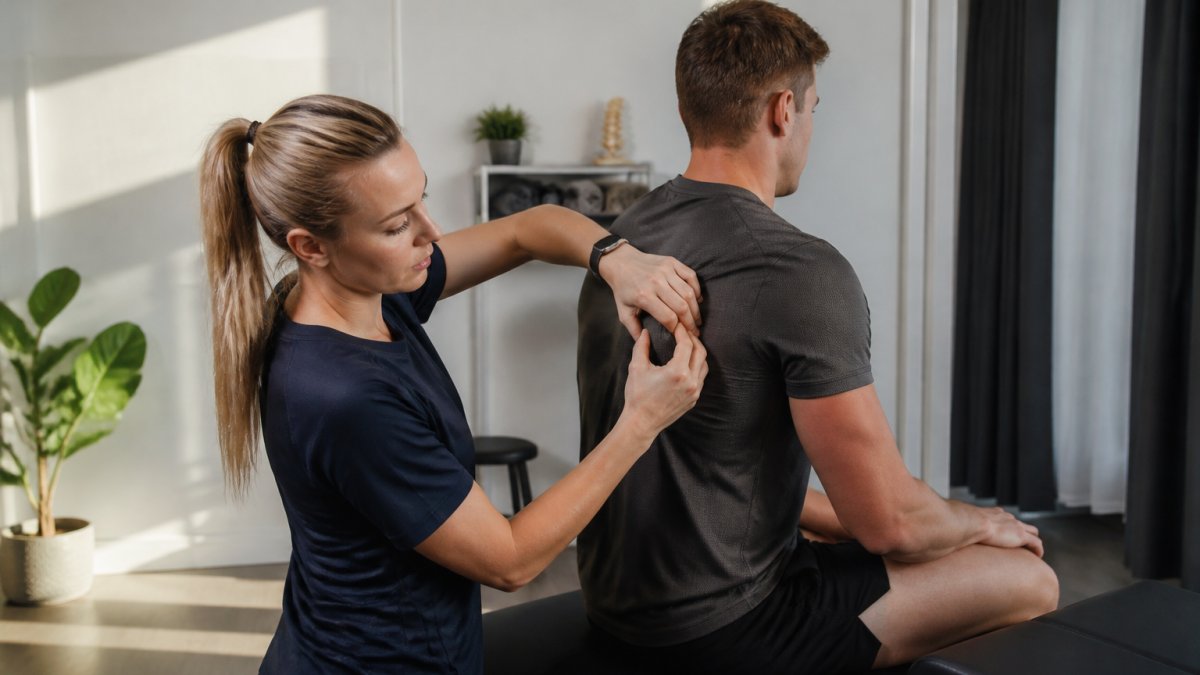
Professional therapist performing hands-on soft tissue mobilisation on patient's shoulder
Soft tissue mobilisation involves direct manual treatment of muscles and connective tissues to reduce tension, improve blood flow, and restore normal tissue mechanics. Unlike general massage, this is targeted treatment addressing specific restrictions limiting your movement.
Assisted stretching goes beyond what you can achieve alone. A trained therapist applies precise stretching angles and progression, accounting for your individual biomechanics and pain responses. This is particularly effective for chronic tightness that home stretching hasn't resolved.
Check availability and book online →
Neuromuscular facilitation uses specific techniques to retrain how your nervous system controls muscle activation. Many people develop poor movement patterns after injury or during chronic pain, your body essentially "forgets" how to use certain muscles correctly.
Targeted exercise rehabilitation forms the backbone of recovery. Rather than generic exercises, sports therapy rehabilitation is tailored to your specific injury, your current movement capacity, and your return-to-activity goals.
Biomechanical assessment identifies movement faults contributing to your pain. Someone with chronic knee pain might have a hip stability issue or altered running mechanics. Addressing the root cause, not just the painful area, prevents recurrence.
At Marlow Movement Clinic, we combine these approaches into personalised rehabilitation plans. The treatment isn't just what happens in the clinic, it's the actionable steps you take between sessions, with clear progression markers so you know you're moving forward.
Musculoskeletal Rehabilitation: What to Expect
Musculoskeletal rehabilitation follows a logical progression, though the timeline varies depending on your injury severity and how consistently you engage with the process.
Initial assessment involves understanding your injury history, current symptoms, movement restrictions, and return-to-activity goals. A thorough assessment identifies what's actually limiting you, sometimes the painful area isn't the root cause. For example, chronic shoulder pain might stem from poor scapular stability or thoracic spine stiffness.
Early-phase rehabilitation focuses on pain reduction and restoring basic movement. This might involve soft tissue work, gentle mobilisation, and initial activation exercises. The goal is to reduce inflammation and begin restoring normal movement patterns without aggravating the injury.
Mid-phase rehabilitation introduces progressive strengthening and stability work. As pain decreases and basic movement improves, you begin loading the injured tissues more substantially. This phase is where most people see meaningful functional improvements, you can do more without pain.
Late-phase rehabilitation emphasises returning to your specific activities. If you're a runner, this means running-specific drills and progressions. If you're an office worker, it means postural endurance and repetitive movement tolerance. The rehabilitation becomes increasingly specific to your goals.
Return-to-activity isn't a single moment, it's a graduated process. Rather than jumping from "rehabilitation exercises" to "full activity," there's a progressive return. This prevents re-injury and builds confidence in your recovered movement.
Common mistakes include stopping treatment too early (when pain reduces but function and strength hasn't fully returned), attempting return to activity too quickly, or doing rehabilitation exercises inconsistently or ‘skipping a drill before mastering it. A good clinic will manage these risks through clear communication about what each phase involves and why the progression matters.
How to Evaluate a Clinic for Your Needs
When comparing clinics, several practical factors should guide your decision.
Specialisation depth matters most if you have a specific injury or chronic musculoskeletal condition. Ask whether the clinic focuses primarily on musculoskeletal care or offers multiple service lines. Does the staff have specific expertise in your injury type?
Hands-on treatment availability varies between clinics. Some rely heavily on exercise prescription alone; others combine hands-on therapy with exercise. If you respond well to manual treatment, ensure the clinic includes this in their approach.
Appointment accessibility affects consistency. Can you get same-day or next-day appointments when needed? Rehabilitation works best with regular, timely treatment. Long waiting lists can undermine progress.
Check availability and book online →
Treatment planning clarity is essential. Does the clinic explain what each phase of rehabilitation involves? Can they give you a realistic timeline and clear progression markers? Vague treatment plans suggest unclear thinking about your rehabilitation.
Communication between sessions makes a real difference. Do they provide written exercise progressions? Can you contact them with questions? Is there a system for tracking your progress?
Cost transparency matters practically. Ask about pricing structure upfront. Many clinics offer free initial consultations, use these to understand costs before committing.
At Marlow Movement Clinic, we offer free 15-minute phone consultations specifically so you can ask these questions before booking. Same-day appointments are often available, and we provide clear written rehabilitation plans with actionable steps between sessions.
Why Specialisation and Hands-On Care Matter
The most effective rehabilitation combines two elements: hands-on treatment addressing tissue restrictions and systematic exercise rehabilitation building strength and movement control. Neither alone is sufficient for most musculoskeletal injuries.
Hands-on treatment, soft tissue mobilisation, joint mobilisation, assisted stretching, addresses what your body can't fix through exercise alone. Chronic muscle tension, joint stiffness, and scar tissue restrictions often require direct manual intervention. Without this, you might do exercises consistently yet still feel limited.
Exercise rehabilitation, meanwhile, builds the strength and movement control that prevents re-injury. You can have the best manual treatment in the world, but if your stabilising muscles remain weak, you'll re-injure the same area.
A clinic focused exclusively on one approach, whether hands-on only or exercise-only, leaves half the problem unaddressed. Specialisation in musculoskeletal care means the clinic understands how to integrate both elements into a coherent rehabilitation plan.
The evidence increasingly supports combined approaches. When manual treatment is paired with progressive exercise rehabilitation tailored to your specific injury and goals, recovery is faster and more complete than either approach alone.
Choosing the right clinic for musculoskeletal pain or sports injury recovery is ultimately about finding practitioners who understand your specific situation and can deliver both the hands-on treatment and systematic exercise rehabilitation your recovery requires. When you're evaluating any local clinic, look beyond marketing claims to ask about specialisation depth, hands-on treatment availability, appointment accessibility, and treatment planning clarity.
At Marlow Movement Clinic, our entire focus centres on musculoskeletal rehabilitation, from acute sports injuries to chronic pain affecting your daily activities. We combine hands-on soft tissue mobilisation, assisted stretching, and targeted exercise rehabilitation with clear, actionable progression plans. If you're recovering from a sports injury or managing chronic musculoskeletal pain, book a free 15-minute phone consultation to discuss your specific situation and how we can help you regain confident movement.
Frequently Asked Questions
What is the difference between physiotherapy and sports therapy?
Graduate anatomy and physiology education is the same for both. Basic physiotherapy training focuses on getting people out of a hospital bed and back to home or work. Sports therapy training is based on treating musculoskeletal pain and outpatient rehabilitation from the start, focusing on people who can work and do simple daily tasks but struggle getting back to their favourite exercise or sport.
What sort of treatments does Marlow Movement Clinic provide?
Graduate Sports Therapy at Marlow Movement Clinic is focused on making the musculoskeletal system work better through bones, joints, muscles and soft tissue structures. Treatment is based around exercise physiology, biomechanics, neuromuscular facilitation, assisted stretching, soft tissue mobilisation and targeted exercise rehabilitation.
How should I compare two physical medicine or rehabilitation clinics?
Look for clinics that offer hands-on treatment combined with practical rehabilitation plans, have availability that suits your schedule, and specialise in your specific injury type. Check reviews from people with similar conditions, ask about their approach to getting you back to your goals (whether that's sport, work, or daily activities), and consider whether they offer free initial consultations so you can discuss your needs before committing.
What questions should I ask before booking a musculoskeletal appointment?
Ask about their specialisations and how they treat your specific injury, whether they combine hands-on therapy with exercise-based rehabilitation, what your typical appointment would involve, how long recovery typically takes for your condition, and whether they offer same-day or flexible appointments. Also ask if they provide a clear plan for progress between sessions and what qualifications their practitioners hold.