 listicle
7 Rehab Exercises for Repetitive Strain Injury
Table of Contents
- What Repetitive Strain Injury Is and Why Exercise Matters
- RSI Wrist Exercises to Restore Mobility
- RSI Hand Exercises for Strength and Flexibility
- Nerve-Gliding and Stretching Exercises
- How Often to Do RSI Exercises for Best Results
- Repetitive Strain Injury Recovery Time: What to Expect
- When to Seek Professional Support
- Conclusion
- Frequently Asked Questions
Last Updated: 7 October 2026
What Repetitive Strain Injury Is and Why Exercise Matters
Repetitive strain injury (RSI) develops when you perform the same movement repeatedly over time, causing pain and reduced function in the affected area, which is why rehab exercises for repetitive strain injury are so important to recovery. At Marlow Movement Clinic, we work with clients across all backgrounds, from office workers to athletes and active adults managing chronic discomfort, to understand that RSI isn't simply about rest.
The confusion around RSI stems from how it develops. Unlike a sudden injury from a fall or collision, RSI builds gradually. Your muscles, tendons, and nerves adapt poorly to repetitive demands. Inflammation accumulates. Mobility decreases. Strength imbalances emerge. Without intervention, the cycle deepens.
This is where rehab exercises for repetitive strain injury become essential. Exercise addresses the root cause, restoring mobility, rebuilding strength, and retraining movement patterns and muscle imbalances, rather than simply masking symptoms. The right exercises reduce pain, improve function, and help you return to the activities that matter most to you.
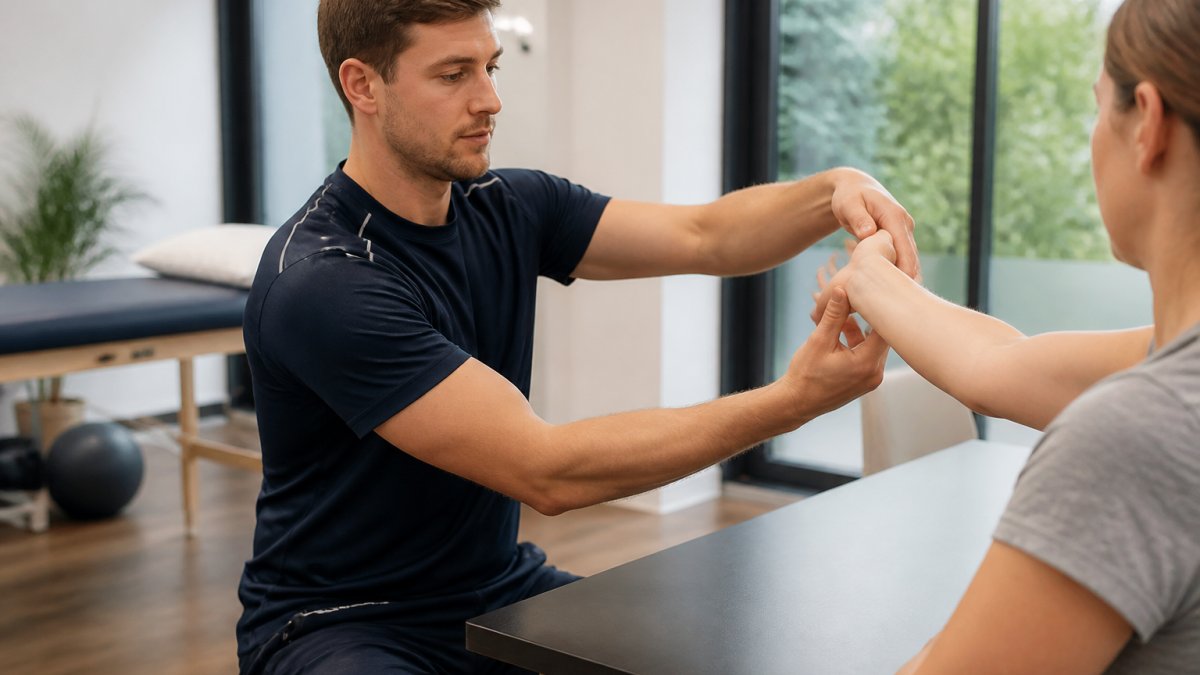
Professional demonstrating hand and wrist stretching technique to help address carpal tunnel syndrome
Below, we've outlined exercises that form the foundation of RSI rehabilitation. Each targets a specific aspect of recovery: mobility restoration, strength building, and nerve function. The exercises work best when performed consistently and with proper form, which is why we recommend working with a qualified professional to ensure you're executing them correctly from the start.
RSI Wrist Exercises to Restore Mobility
Wrist mobility is foundational for most people managing repetitive strain injury. When your wrist cannot move freely, the muscles and tendons around it work harder to compensate, perpetuating pain and dysfunction.
Wrist flexion and extension stretches form the starting point. Extend one arm in front of you with the palm facing down. Using your opposite hand, gently press the back of your hand downward to stretch the top of your forearm.
Radial and ulnar deviation addresses side-to-side wrist movement. Hold your forearm still on a table with your hand hanging off the edge.
Pronation and supination exercises involve rotating your forearm. Hold your arm at a 90-degree angle with your elbow at your side. Rotate your forearm so your palm faces down (pronation), then rotate it so your palm faces up (supination).
These wrist exercises for RSI should be pain-free. If you experience sharp pain, stop immediately and consult a qualified professional. Mild discomfort during stretching is normal; sharp pain is a warning sign. A forearm stretching routine is available here.
RSI Hand Exercises for Strength and Flexibility
Hand strength underpins grip, dexterity, and the ability to perform fine motor tasks without compensation. Many people with RSI develop weakness in their hands because pain causes them to avoid using the affected area.
Grip strengthening with a therapy ball or soft stress ball is straightforward and effective. Squeeze the ball for 5 seconds, release, and rest for 5 seconds. Perform 10-15 repetitions.
Finger isolation exercises build independent finger control. Place your hand flat on a table. Lift one finger at a time while keeping the others flat. Hold each lift for 2-3 seconds. Repeat 10 times per finger.
Intrinsic hand muscle activation involves making a "claw" shape with your hand. Bend your fingers at the knuckles while keeping your palm flat and fingers extended at the base joints.
Thumb opposition exercises strengthen the muscle connecting your thumb to your fingers. Touch your thumb to the tip of each finger in sequence, then reverse the pattern. Perform 2-3 sets of 10 repetitions.
Check availability and book online →
RSI hand exercises should never cause sharp pain. Mild fatigue in the muscles is expected; burning pain or tingling suggests you need to reduce intensity or stop.
Nerve-Gliding and Stretching Exercises
Nerves in your wrist, forearm, and hand can become irritated and restricted when surrounded by inflamed tissue. Nerve-gliding exercises help these structures move freely again, reducing pressure and pain.
The median nerve gliding sequence targets the nerve running through your wrist and into your palm. Start with your arm at your side, palm facing forward. Make a fist, then straighten your fingers while keeping your wrist straight.
Ulnar nerve gliding addresses the nerve on the little-finger side of your forearm. Extend your arm in front of you with your palm up. Make a fist, then straighten your fingers while bending your wrist upward. Next, rotate your arm so your palm faces down.
General forearm stretches complement nerve-gliding work. With your arm extended, press the back of your hand downward using your opposite hand, holding for 20-30 seconds. Repeat on the opposite side. These stretches reduce overall tension in the forearm, creating space for nerves to function properly.
Nerve-gliding exercises should feel like a gentle movement through the forearm, not sharp pain. Some mild tingling is normal as the nerve moves; severe tingling or numbness means you should stop and rest.
How Often to Do RSI Exercises for Best Results
Consistency trumps intensity when managing repetitive strain injury. Most people see meaningful improvement with daily exercise performed for 10-15 minutes.
Exercise Type | Frequency | Duration | Rest Days |
|---|---|---|---|
Stretching and mobility | Daily | 5-10 minutes | None required |
Strengthening exercises | 3-4 times per week | 5-10 minutes | At least 1 day between sessions |
Nerve-gliding exercises | Daily | 5 minutes | None required |
Combined routine | Daily | 15-20 minutes | 1 day per week optional |
The pattern that works best for most people is daily stretching and nerve-gliding, combined with strengthening exercises on alternate days. This approach provides consistent stimulus without overloading healing tissue.
Pain should guide your progression. If an exercise causes pain during or immediately after, reduce the intensity or frequency. Delayed-onset soreness (appearing 24-48 hours later) is normal; sharp, immediate pain is a sign to modify or stop.
Many people benefit from performing exercises at the same time each day, first thing in the morning or during a work break. This builds habit and ensures consistency.
Repetitive Strain Injury Recovery Time: What to Expect
Recovery timelines vary significantly based on the severity of your RSI, how long you've had it, and your adherence to rehabilitation. Mild cases may improve within 4-6 weeks. More significant injuries often require 8-12 weeks of consistent exercise and activity modification.
Early-stage RSI, pain that's present but hasn't significantly limited function, typically responds quickly to exercise. You may notice reduced pain within 2-3 weeks and meaningful functional improvement within 6-8 weeks.
Chronic RSI that's persisted for months or years requires patience. Your tissues have adapted to dysfunction over an extended period, and retraining takes time. Expect 12-16 weeks of consistent effort before reaching full recovery.
Several factors accelerate recovery. Addressing ergonomics and activity patterns prevents re-injury. Combining exercises with hands-on treatment, soft tissue mobilisation, assisted stretching, and neuromuscular facilitation, can often produce faster results than exercise alone.
Setbacks are common. You may experience temporary increases in pain when you progress exercises or return to activities. This doesn't mean you've failed; it means you've challenged your tissues appropriately. The key is distinguishing between acceptable discomfort (mild soreness) and warning signs (sharp pain, swelling, numbness).
Check availability and book online →
When to Seek Professional Support
Exercise is powerful, but it's not always sufficient on its own. Several situations warrant professional evaluation and hands-on treatment.
Seek support if pain persists despite 4-6 weeks of consistent exercise. This suggests either the exercises aren't addressing your specific dysfunction, or additional factors, postural habits, ergonomic issues, muscle imbalances, are perpetuating the problem.
Severe pain that limits basic activities (typing, gripping, writing) requires professional assessment before starting self-directed exercise. A qualified professional can identify the underlying cause and ensure your exercises are appropriate for your specific presentation.
Numbness, tingling, or weakness that doesn't improve with exercise may indicate nerve compression requiring specialist evaluation. These symptoms sometimes improve with exercise, but professional guidance ensures you're not missing a condition requiring different intervention.
Recurring RSI, pain that resolves, then returns when you resume activities, points to incomplete rehabilitation or inadequate activity modification. A professional can identify what's driving the recurrence and help you address it permanently.
At Marlow Movement Clinic, our approach combines hands-on treatment with movement-based rehabilitation. We assess your specific dysfunction, teach you exercises tailored to your needs, and provide the guidance that transforms isolated movements into lasting recovery.
Conclusion
Repetitive strain injury responds well to the right exercise approach. Wrist mobility work, hand strengthening, and nerve-gliding exercises form the foundation of recovery. Consistency matters far more than intensity, daily practice of 10-15 minutes beats sporadic intense sessions.
Recovery takes time. Most people see meaningful improvement within 6-8 weeks; more chronic cases require 12-16 weeks of sustained effort. Your role is to perform exercises correctly, modify the activities causing the problem, and progress gradually as your capacity improves.
If your RSI isn't improving with self-directed exercise, or if you're uncertain whether you're performing exercises correctly, professional assessment can accelerate your recovery. Marlow Movement Clinic specialises in musculoskeletal rehabilitation, combining hands-on treatment with targeted exercise programmes. We assess your specific dysfunction, teach you exercises tailored to your injury, and provide the expert guidance that transforms exercise into lasting results. Book a free 15-minute phone consultation to discuss your situation and learn how we can help you return to pain-free movement.
Frequently Asked Questions
What exercises can help with repetitive strain injury?
Rehab exercises for repetitive strain injury include wrist stretches, hand-strengthening drills, nerve-gliding movements, and postural corrections. Wrist exercises target flexibility and range of motion, while hand exercises build strength in muscles weakened by overuse. Nerve-gliding work helps reduce compression and improve nerve mobility. The most effective approach combines stretching, strengthening, and movement quality—tailored to your specific injury location and severity. A qualified professional can assess your needs and design a programme suited to your recovery.
How often should I do exercises for repetitive strain injury?
Most RSI exercise programmes work best when performed daily or at least five days per week. A typical routine takes 15 minutes and can be split across the day. Starting conservatively—perhaps three sessions per week—allows your tissues to adapt without overload. Consistency matters more than intensity; gentle daily movement often produces better results than sporadic intense sessions. If pain increases during or after exercise, reduce frequency or intensity and consult a professional to adjust your programme.
How long does repetitive strain injury take to improve?
Recovery timelines vary widely depending on injury severity, how long symptoms have been present, and how consistently you follow a rehab programme. Mild RSI may improve within 4 to 8 weeks with proper exercise and activity modification. Chronic cases—lasting months or years—often require 12 weeks or longer of structured rehabilitation. Some people notice relief within days of starting appropriate exercises, whilst others require months of patience. Early intervention generally leads to faster recovery than waiting until pain becomes severe.
What is the difference between sports therapy and other treatment approaches for RSI?
Sports Therapy training focuses specifically on treating musculoskeletal pain and out-patient rehabilitation from the start. It emphasises exercise physiology, biomechanics, and targeted exercise rehabilitation for people who can work and manage daily tasks but struggle returning to sport or favourite activities. A Graduate Sports Therapist uses soft tissue mobilisation, assisted stretching, and neuromuscular facilitation alongside exercise to restore function and confidence in movement—particularly valuable for active individuals seeking to regain performance.
Can I prevent RSI flare-ups once I've recovered?
Yes. Prevention relies on three pillars: regular maintenance exercises, ergonomic awareness, and activity pacing. Continue a simplified version of your rehab routine—even 5 to 10 minutes daily—to maintain strength and flexibility. Adjust your workspace to reduce strain (proper desk height, keyboard position, chair support). Take frequent movement breaks, especially during repetitive tasks. Watch for early warning signs such as mild aching or stiffness, and address them promptly rather than pushing through. Professional guidance can help you identify personal risk factors and build a sustainable prevention plan.